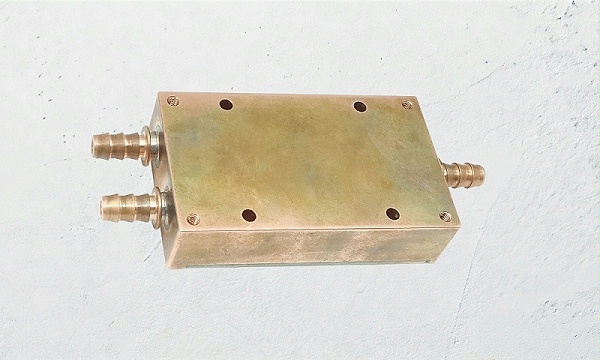
Before leaving the factory, server liquid cooling plates must undergo liquid flow testing and air tightness testing. These two processes have clear requirements for sealed connections: efficiency, no damage, and reliability. The space of small liquid
cooling plates is already compact, and the pagoda tube ports are often arranged side by side with narrow spacing. Conventional quick-seal connectors are relatively large in size, and when two connectors are connected simultaneously, they are prone
to interfere with each other. Operators have to repeatedly adjust the angles or even displace to avoid interference. This not only slows down the testing pace but also increases the risk of damaging the tube ports due to forced operation. The GripSeal
G70SP
series quick-seal connectors are specifically developed for the pagoda tube port structure of liquid cooling plates, addressing the connection challenges in tight spaces from the design stage.
Compact design to avoid spatial interference of side-by-side pipe orifices
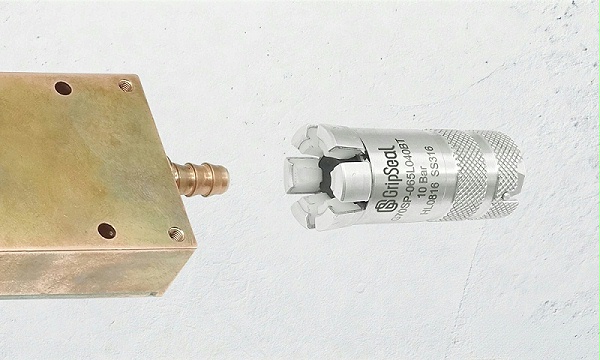
The G70SP series connectors feature a lightweight and compact body structure, with dimensions approximately 5mm smaller than conventional connectors of the same caliber on the market. This size reduction is particularly crucial in
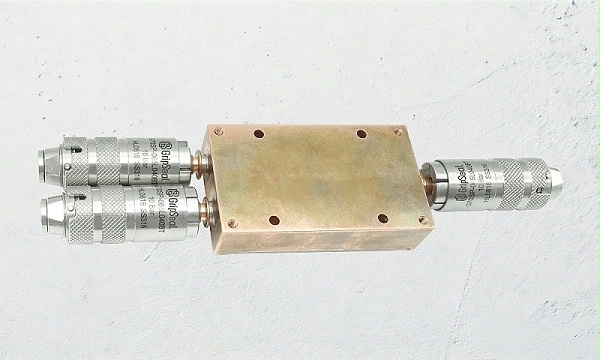
terms of the maximum spacing between side-by-side pipe orifices: when two connectors are simultaneously connected to adjacent pipe orifices, they no longer interfere with each other, eliminating the need for deliberate misalignment or disassembly
to avoid interference. The testing process can proceed smoothly, reducing the risk of pipe orifice damage caused by forced manipulation. For production lines, this non-interfering operation mode directly translates to improved testing continuity and
stability.
Three steps to connect and disconnect cleanly and efficiently
The connection and disconnection of the G70SP series quick-seal coupling are facilitated by its own sliding sleeve structure, eliminating the need for auxiliary tools such as wrenches or pliers throughout the entire process.
Push and grab. Align the connector with the pagoda pipe mouth and gently push it in. The built-in polymer locking claw will automatically grip the protruding part of the pipe mouth, completing the initial positioning.
Rotating and locking.
Rotate the anti-loosening knob clockwise to fully lock the connector. In the case of test pressure fluctuations or cable dragging, the locked state will not loosen, eliminating the risk of leakage.
Pull to disconnect. After the test is complete, reset the knob, hold the sliding sleeve and gently pull it backward. The connector can be quickly pulled out, instantly switching positions.
The entire operation process allows for controllable force, ensuring that repeated insertion and extraction will not cause additional wear to the nozzle.
Three core features, balancing durability and losslessness
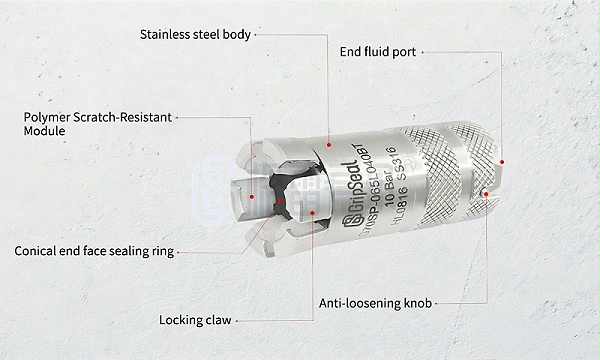
Pressure-resistant and corrosion-resistant, durable. The 316 stainless steel body possesses excellent compressive strength and corrosion resistance, with an operating pressure range from vacuum to 10Bar, meeting the conventional pressure requirements
for liquid cooling plate fluid testing and air tightness testing. Under high-frequency, high-pressure testing conditions, the sealing performance remains stable, and the joint itself is less prone to performance degradation.
Lossless connection, safeguarding the quality of the pipe orifice. The polymer locking claw provides sufficient radial clamping force while ensuring a gentler contact with the outer wall of the pipe orifice. Compared to the direct biting method
of traditional metal claws, this design effectively avoids scratches and deformation, allowing the pagoda-shaped pipe orifice to remain intact after testing, without affecting subsequent assembly processes.
Compact and lightweight, suitable for
narrow spaces. While ensuring locking and sealing performance, the
G70SP series connectors have been compressed to a smaller size compared to similar products. Even on liquid-cooled boards with extremely limited nozzle spacing, two connectors
can independently complete connection and disconnection, leaving sufficient margin for manual operation and providing greater flexibility for fixture design and workstation layout in automated production lines.
The sealing test process for liquid cooling plates appears to be a simple action of "connecting, testing, and disconnecting" on the surface, but behind it lie practical requirements for the dimensional accuracy of quick sealing connectors, locking
reliability, and nozzle protection capabilities. The GripSeal G70SP series, with its compact body design, polymer locking structure, and simple three-step operation process, makes the sealing connection of small liquid cooling plate pagoda nozzles
more efficient and provides predictable guarantees for the stability and continuity of production line testing.